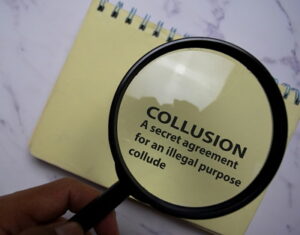
 There has always been, and probably always will be, controversy surrounding sportsbooks, and the gambling scene in general, too. It’s one of those industries that will never be able to please everyone completely. And this is why controversy often arises, regardless of whether that is based on fact or fiction.
But one question that has been asked a few times is whether or not bookmakers are in collusion with one another. After all, the sports betting scene is dominated by four or five huge bookies today. Can it be said that these bookmakers all work together to ensure higher margins, more profit and so on?
If you look back in history, you’ll be able to see that several instances of collusion accusations have been put forward surrounding the sports betting scene. Yet in most instances, the companies have been cleared of any collusion.
The question remains, though – do bookmakers engage in collusion with one another? This is an important question since the global gambling market is becoming ever more dominated by a handful of companies, meaning if they do collude it could effect a huge amount of people. We’re going to take a closer look at this and see if anything has been proven in history, and if these brands do work together in such a way, why do they do it?
Collusion Accusation Example


The event that this supposedly occurred at was the Ffos Las Racecourse and Conference Centre in south-west Wales in the summer of 2017. The accusation relating to this event came from bookmaker Andy Smith, who had been trading at the Carmarthenshire racetrack under the brand name of Festival Racing. A report was published in The Guardian newspaper, which stated that Andy had accused various other bookies of working together so as to provide notably poor odds to racegoers attending the event.
Those odds had been visibly poorer than they should have been, according to Andy, and this, he said, was displayed throughout the 2017 season. However, he highlighted the event taking place on August 25 as being much more particularly inferior overall. Official figures suggested that around 6,000 people had attended the Ffos Las Racecourse and Conference Centre for Ladies’ Day. Yet Smith said that about seven of the other bookies offering wagers to attendees had utilised that event for their own benefit by fleecing inexperienced gamblers.
This led to him making the bold statement that bookmakers collude with one another to rip off punters. While being known for his outspoken views, Smith said that he knew bookies would sometimes agree to build a particularly large profit margin into their odds before racing starts. And this, he said, is particularly common when a large crowd of gamblers are expected, who come without prior knowledge or experience of how to proceed with gambling.
His comments on this practice had actually been prompted by a survey that had been published by the Horseracing Bettors Forum. That survey displayed odds offered at the racetrack being notably poorer in 2017, especially on that Ladies’ Day event.
“Because there’s not many bookies, it was easy to arrange, let’s think of a word for it…a cartel. A bookie would come and ask you, one of the other bookies. They might say, we’ll do 3% the first couple of races, then we’re betting 4%”, he said on the matter, referring to the theoretical profit margin built into the odds per horse. When the percentage gets bigger, the odds become shorter, meaning that the money being returned to punters also decreases. A margin should be lower than 2% in a competitive betting market.
Smith himself did participate in the collusion between the bookies on that August 25 event, but commented on how much he deplores the practice. He stands for racecourse punters being able to access online betting exchanges, where the odds can be larger. Bookmakers are already able to access those sites, and it is these that they utilise as a way of hedging their own liabilities.
He also cited another instance at Wolverhampton in 2017, where there was a 100-1 winner. The owner had backed that horse with a bookmaker. That same bookmaker then backed it back on the machine. The bookie ended up winning six times more than the man who is the one paying for the upkeep of that horse.
Does This Happen with the Larger Bookmakers?
 It would seem only logical that if racecourse bookies are participating in such activity, that the larger companies would be, too. Especially considering that the industry today is pretty much dominated in the UK by a few big-name brands, rather than multiple betting companies. Yet in the same example mentioned above, Smith did mention that the William Hill brand, which does have a pitch at the Ffos Las, was not involved in the collusion. To further corroborate this, a William Hill spokesman said that the on-course representative for its brand had never even been approached regarding such.
While this may be the case in this instance, there have been reports of bookmakers betting against one another as a way of balancing their respective books. And while this may seem like quite a silly thing for such companies to partake in, it is not unheard of at all. It is actually quite a common practice within the industry, it seems. Doing so allows them to easily offset their liabilities against one another, if their books are actually out of balance. Therefore, the odds are evened out to a more house-friendly level. Can this be considered as collusion, though? And do the companies simply choose to contact each other and sort that out when they find their books aren’t balanced?
Anyone who is experienced enough with placing sports bets will know that all bookmakers need to incorporate a way of making money into their odds. And this is why they adjust the prices in a very slight way, so as to benefit themselves. Any perfect book, before factoring in a profit (margin) for the bookmaker, would mean that the implied probability of any and all outcomes should add up to 100%. Bookmakers therefore make use of something known as overround, and this allows that probability to go beyond the 100% mark. The extra (overround) is the profit that they themselves earn.
Despite the fact that the creation of overround has allowed bookies to generate their own profit through some key mathematics, it is not so easy for the overround to remain static while the remaining factors affecting this change. Bettors are not known for consistently placing equal wagers on all outcomes of a market. Generally speaking, a larger portion of players will back a specific outcome more so than the other. This is why sportsbooks provide shorter odds on one option and lengthen the ones on the other. And it is during this time that there is great care utilised in protecting the overround. After all, no bookie wants to lose out on their profit.
How would two bookmakers collude with each other to balance their books? Let’s use a random example here. Let’s say that an English football team are going to be playing a match against Italy’s Inter Milan. Naturally, many British gamblers will outwardly back the home team, while the same is true in reverse for Italian bettors. In this respect, the likelihood is that a British bookie would have more wagers on England winning, and vice versa for a Italian bookmaker. This means that the books would not be balanced at either sportsbook. Each is overexposed on different sides.
The British bookmaker can then make a choice. The first route is to go ahead with the risk that the English team will lose and thereby it will acquire a lot of profit from the overexposed wagers on England winning. Of course, that risk is not something that a legitimate bookmaker would want to take. Instead, liabilities will be laid with other bookmakers. This is a similar sort of action to what many players do through betting exchanges. In our example, the British bookie would essentially lay the overall liability with the Italian bookmaker, and vice versa would also occur. Both bookies therefore end up making a small profit regardless of the outcome of the football match itself.
Is that considered collusion, though? Well, perhaps it could be in a minor way. Alas, it is really the businesses looking to garner as much profit as they possibly can from wagers being placed on their respective sites. Wholesale bookmakers would step in whenever books need to be balanced, and they cover the sportsbooks about 99% of the time.
Historical Practice in Effect
 The types of collusion mentioned are not particularly new practices, though. In fact, throughout history, bookmakers have been known to collaborate closely with their competition for one reason or another. If you look back to the 1950s, big firms were popping up across the length and breadth of the United Kingdom, providing punters with the possibility of placing bets on horse races and greyhound racing. These companies were employing odds-makers so that they could help them compile what became known as the “tissue” for each race taking place.
That served as the first show of prices at the bookmakers. Without a doubt, these sports betting brands would collude with one another as a way of checking their assessments of the market were not somewhat wildly out of place. Of course, while they would usually be quite happy to trust their own instincts on that, it was not uncommon for them to simply check with their competition and enter into some form of collusion to ensure prices were good enough for players but also profitable for them.
Even back then, prices on events were not static. Instead, they moved to respond to market forces once the tissue was displayed on the boards. Back then though, they could simply combat liabilities by scrubbing out the prices on the board within the betting shop and replacing them with less favourable prices.
Of course, it would not be beyond the bounds of standard thinking to believe that those practices remain in force today. No bookmaker wants to find themselves suffering liabilities, and so it could be that there is an interior agreement between the big-name brands currently offering odds in the UK to collude on their odds and price margins. This then ensures that none of them are falling into the deep end when it comes to profit and potentially losing out on it.
The likelihood is that this practice has simply continued throughout the proceeding years, although simply becoming a lot more refined. In this respect, not as many people are likely to know about it taking place, especially with the dawn of online sports betting.
One question that stands is whether or not it actually matters? Well, it all depends upon what sort of odds and prices the collusion between bookies is coming up with. If these are less-than favourable, as in the case of Andy Smith and the horse racing collusion in 2017, then it doesn’t benefit a bettor to get involved in wagering at all. Yet if you’re a novice punter, as he suggested the majority were at that race, then you’re not going to be able to realise the difference.
Yet that type of collusion between companies could also be a good thing for bettors. If they’re setting their prices together with both themselves and the gamblers in mind, then it stands to reason that everyone is getting to benefit from it. There will always be winners and losers when it comes to sports betting, and gambling in general. The question that remains is whether collusion will lead to fair wins and losses or corruption in favour of the bookies.